Snagging in Dubai: Handover Checklist for New Homes
Your developer has sent the completion notice, the final payment is lined up, and a handover appointment is in the diary. Before you sign anything, there is one job that protects you more than any other: snagging.
This guide explains what snagging means in Dubai, when to do it, what to check room by room, how to send your snag list to the developer, and what the law says about defects after you take the keys.
In short: Snagging is not a legal requirement in Dubai, but it is the last point where you have real leverage. Inspect after the completion notice and before you sign the handover form, send a numbered snag list with photos through the developer’s official channel, get repair dates in writing, and re-check before you accept.

What is snagging in Dubai?
A snag is a defect or unfinished item in a new property: a cracked tile, a door that will not close, an AC unit that does not cool, a balcony drain that pools water. Snagging is the inspection where you find and record those items so the developer fixes them.
In Dubai, snagging usually happens as part of the handover of an off-plan apartment or villa. The process is the same idea as UK new-build snagging (read what snagging is for the basics), but the paperwork, utilities and legal periods are different.
Is snagging mandatory in Dubai?
No. No regulation obliges a buyer to carry out a snagging inspection, and you can do it yourself or hire a snagging company (Fidu Properties). It is still strongly advisable: once you sign for handover, you negotiate from a weaker position, and some cover for installations only lasts a year (see the legal section below).
The Dubai handover process, step by step
Most off-plan handovers follow the same order (NVM Partners; Al Kareem):
- Completion notice.The developer tells you the building is complete and sets out the final payment and the handover process. Note any deadline it gives you and book your slot early.
- Final payment and fees.Settle the balance and any fees the developer lists.
- Utilities.Open your DEWA account and, where the building uses it, register for district cooling. Without power and water you cannot test anything.
- Snagging inspection.Inspect the home and list every defect.
- Fixes and re-check.The developer repairs the snags; you re-inspect.
- Keys and title deed.Sign the handover documents and collect the keys. Once the price is paid in full, the Oqood registration is converted into a title deed in your name.
The key point is the order: snag before you sign, not after.
What to bring to the inspection
- Your sale and purchase agreement (SPA), including the unit plan and the list of fittings and appliances promised.
- Payment receipts, your Oqood registration and any no-objection certificate the developer asks for.
- Passport or Emirates ID (a representative needs a power of attorney).
- A phone with plenty of storage and charge, a torch, a spirit level, a tape measure, a socket tester, and a few coins or a ball to check floor and balcony falls.
- Proof that DEWA (and district cooling, where relevant) is active.
Dubai snagging checklist, room by room
Inspect in daylight, with the water running and every AC unit switched on. The list below covers what matters most in a Dubai apartment or villa. For a longer general list, use our new-build snagging checklist.
Walls, ceilings and paint
- Cracks, patchy paint, uneven plaster and marks.
- Damp patches or staining near windows, bathrooms and AC units.
Floors and tiles
- Cracked, chipped or hollow-sounding tiles (tap them).
- Uneven tiles, lippage between tiles, and missing grout or silicone.
Doors, windows and balcony doors
- Doors and windows that stick, rub or do not lock.
- Gaps in seals that let in dust, heat or water.
- Sliding balcony doors: running smoothly, tracks clean, sealant complete where the frame meets the floor.
Air conditioning and district cooling
- Every unit cools, with no water dripping and no unusual noise.
- Thermostats work in each room.
- Condensate drains are not leaking into ceilings or cupboards.
Plumbing and bathrooms
- No leaks under sinks, around toilets or behind access panels.
- Hot water and good pressure at every tap and shower.
- Drains empty quickly, including the balcony drain.
- Silicone around baths, showers and basins is complete.
Electrical
- Every socket, switch and light works.
- The distribution board is labelled and nothing trips.
Kitchen and appliances
- Appliances listed in the SPA are installed and working.
- Cabinet doors and drawers align and close properly.
Balcony and outside
- Water drains towards the outlet and does not pool.
- Railings are firm, glass panels are undamaged.
- Your parking bay and storage match the SPA.
Size and finishes
- Measure the main rooms and compare with the SPA plan. The SPA sets any area tolerance.
- Finishes, tile type and sanitaryware match the SPA or the show apartment.
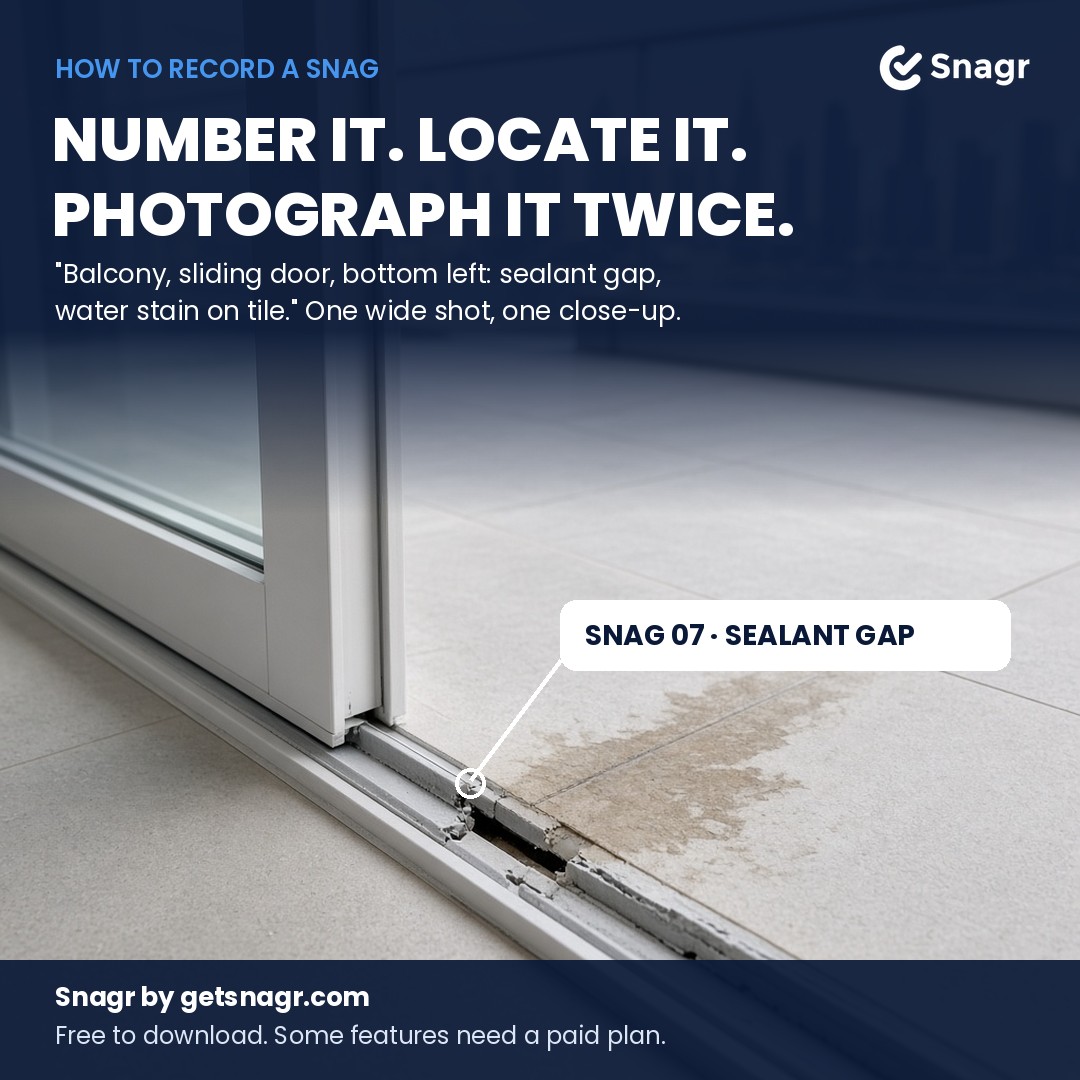
How to record your snags
A snag list is only useful if the developer can find each item quickly. For every snag:
- Give it a number and note the room and exact location (for example, “Balcony, sliding door, bottom left corner”).
- Describe the fault in plain words and what “fixed” should look like.
- Take two photos: a wide shot showing where it is, and a close-up. (Continental Club)
- Keep one list for the whole unit, in a single numbered table: number, room, item, fault, photo reference.
You can do this on paper, in a spreadsheet, or in an app. With Snagr you record each snag with a photo or video and its location, add up to five images to a snag, annotate photos, then share the report by link (£5.99) or export it as a PDF (£19.99) to send to the developer. It also works without signal, which helps in new buildings where mobile coverage is patchy, and syncs to the cloud once you are back online. Snagr is available on iPhone, iPad and Android. Free to snag. Share your report from £5.99 per property.
For more on writing up what you find, see how to write a snagging report.
How to submit your snag list to the developer
- Use the developer’s official channel, such as their handover portal or customer care email, and keep the delivery confirmation.
- Ask for written acknowledgement of the list, and if you are on site, ask the handover representative to sign it.
- Mark priority: safety, water and electrical issues first, then appliances, AC and doors, then cosmetic items.
- Agree repair dates in writing. The SPA governs timescales, so check what yours says.
- Do not sign a clean handover form against a verbal promise. If defects remain, record them on the form or attach your snag list reference before signing. (betterhomes)
- Re-inspect every item the developer says is fixed, and keep your whole file.
What the law says about defects after handover
Dubai Law No. 6 of 2019, on jointly owned real property, sets two periods in Article 40 (Khaleej Times):
| Type of defect | How long the developer is liable | Starts from |
|---|---|---|
| Structural parts (for example foundations, columns, structural walls, roofs) | 10 years | The project’s completion certificate |
| Installations: mechanical and electrical works, sanitary and sewerage installations and similar | 1 year | Handover of your unit (or the completion certificate, if you do not take possession) |
Separately, the UAE Civil Code sets ten-year liability for contractors and architects for collapse or defects that threaten a building’s stability, and an agreement that tries to remove or limit that liability is void (Mondaq).
What this means in practice: the one-year window for installations is short. Keep your handover snag list and photos, note anything new that appears after you move in, and consider a second inspection before the first year ends.
This is general information, not legal advice. For anything beyond routine defects, check your SPA and speak to a lawyer licensed in the UAE.
Common mistakes to avoid
- Signing before you snag. Book the inspection after the completion notice and before the handover appointment.
- Inspecting without power, water or AC. Many Dubai snags only show when systems are running.
- Moving furniture in early. It can hide defects and makes it harder to show damage was there before you moved in. (Dubai Practical)
- Vague descriptions. “Tile issue” is easy to ignore. “Living room, third tile from balcony door, cracked corner” is not.
- Losing the record. Your snag list and photos support any later claim.
Frequently asked questions
Is snagging mandatory in Dubai?
No. No regulation requires it, and you can inspect yourself or hire a snagging company. It is still worth doing before you sign the handover form, because that is when you have the most leverage.
When should I do snagging in Dubai?
After the developer sends the completion notice and your utilities are active, and before you sign the handover documents. Leave time for the developer to fix the snags and for you to re-check them.
Can I snag after handover?
Yes. It is worth checking again within the first year, while the developer’s one-year liability for installations such as electrical, plumbing and mechanical works is still running.
How long is a developer liable for defects in Dubai?
Under Article 40 of Dubai Law No. 6 of 2019, for 10 years from the completion certificate for structural defects, and for one year from handover for installations such as mechanical, electrical and plumbing works.
What should a Dubai snag list include?
A number for each snag, the room and exact location, a plain description of the fault, and photo references, ideally a wide shot and a close-up for each item.
Can I refuse handover if there are snags?
Check your SPA and take legal advice for significant defects. As a minimum, do not sign a clean handover form on a verbal promise: record outstanding snags on the form or attach your snag list, and get repair dates in writing.
Record every snag before you sign
Snagr lets you capture defects with photos and location, share your report by link or export a numbered PDF, and work without signal on a Dubai handover.
Download SnagrSources
- NVM Partners, “Off-plan handover & snagging in Dubai: a checklist”
- Continental Club, “Snagging Checklist Dubai 2026”
- Khaleej Times, “Dubai: How long are developers responsible for maintenance, defect costs after property handover?”
- Mondaq, “Developers’ Decennial Liability In The UAE Towards The Owners Of The Properties”
- Fidu Properties, “Snagging & Inspection Dubai”
- Al Kareem, “Dubai Property Snagging and Inspection Guide”
- betterhomes, “Property Handover Checklist for Buyers in Dubai”
- Dubai Practical, “Dubai Property Handover Checklist”